Subterranean termites (*Heterotermes aureus*) represent the primary wood-destroying organism across southern Arizona, nesting deep within the arid soil to retain moisture before constructing vertical mud shelter tubes…
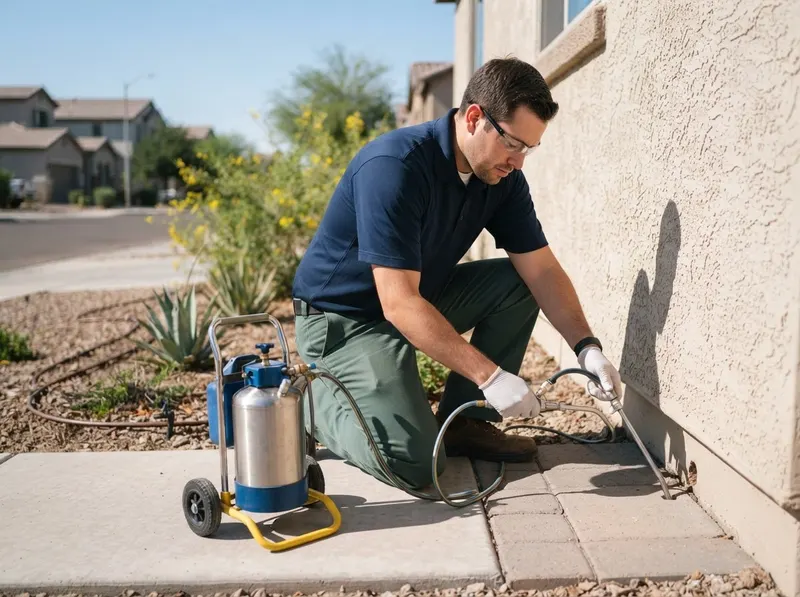
Subterranean termites (*Heterotermes aureus*) represent the primary wood-destroying organism across southern Arizona, nesting deep within the arid soil to retain moisture before constructing vertical mud shelter tubes across concrete stem walls. In master-planned developments such as Fulton Ranch, Ocotillo, and Fox Crossing, expansive clay soils and decorative landscape irrigation lines keep subterranean moisture pockets active year-round. These conditions allow colonies to enter framing through hairline foundation fractures as narrow as 1/32 of an inch. Left unchecked, foraging workers consume cellulose inside structural studs, ceiling joists, and drywall paper linings, leaving fine mud packing along baseboards and hollow-sounding wood beams.
Effective defense requires establishing an uninterrupted, non-repellent liquid chemical barrier through the perimeter soil rather than placing surface baiting systems. While localized foam spot-treatments address immediate worker activity inside an isolated bathroom wall, whole-home perimeter trenching creates a continuous treated zone that foraging termites transfer back to the subterranean reproductive queen, neutralizing the primary nest. In properties with abutting concrete surfaces, such as the covered patios and driveways common in Sun Groves, Clemente Ranch, and Cooper Commons, concrete slab drilling spaced 12 inches apart ensures liquid termiticide reaches the concealed soil beneath the pour.
Structural engineering variations determine treatment mechanics across Chandler. Custom properties with large footprints in Circle G at Riggs Homestead often feature detached workshops, deep perimeter footings, and extensive stem walls requiring high-volume termiticide injection. Conversely, older tract architecture in Galveston and Andersen Springs frequently presents finished floor penetrations where plumbing rough-ins lack modern vapor seals, providing subterranean termites direct vertical access into interior partition walls. Modern liquid barrier compounds bond directly to soil silts, resisting breakdown in the alkaline Maricopa County ground water tables without off-gassing volatile organic compounds into occupied living spaces.
Every job gets a firm, written price after a free on-site visit.
Tell us about your termite control job in Chandler and we'll send a clear, written quote, usually the same day.
 Northwind Pest Control