Sonoran Desert heat accelerates the life cycle of Rhipicephalus sanguineus, commonly known as the brown dog tick. Unlike standard woodland ticks, this species thrives in dry, triple-digit temperatures and establishes…
Sonoran Desert heat accelerates the life cycle of Rhipicephalus sanguineus, commonly known as the brown dog tick. Unlike standard woodland ticks, this species thrives in dry, triple-digit temperatures and establishes indoor colonies within drywall crevices, floorboards, and structural block walls throughout Maricopa County. Properties in master-planned communities such as Fulton Ranch, Ocotillo, and Clemente Ranch frequently experience tick migrations along irrigated common-area turf and walking trails. Flea populations, predominantly Ctenocephalides felis, multiply rapidly inside irrigated grass patches and shaded desert gravel where family pets rest, transferring into indoor carpets and upholstered furniture.
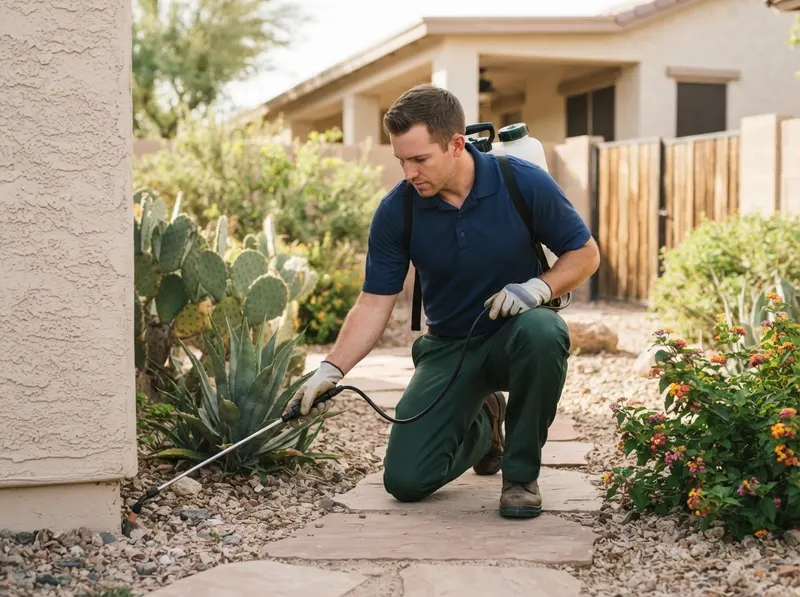
Effective mitigation requires an integrated multi-zone application. Technicians apply an adulticide to eliminate active, biting specimens alongside an insect growth regulator (IGR) containing pyriproxyfen or novaluron. The growth regulator breaks the 21-day reproductive cycle by inhibiting egg hatching and preventing larval molting. Outdoor applications prioritize shaded microclimates, artificial turf perimeters, expansion joints, and block-wall foundations where ticks climb to escape intense sun exposure in neighborhoods like Sun Groves, Fox Crossing, and Cooper Commons. Interior treatments isolate baseboards, under-cushion zones, and pet bedding margins. Occupants and companion animals must vacate the treated structure for 3 to 4 hours until liquid barriers dry completely.
Choosing dedicated professional remediation over consumer topical sprays prevents systemic re-infestation. Over-the-counter surface sprays merely repel pests into wall voids or ceiling junctions, creating hidden breeding reservoirs. A complete premise treatment addresses the ambient environmental population, which represents 95 percent of an active infestation in the form of dormant pupae, larvae, and eggs. Properties with mature oleanders, thick ground cover, or irrigated lawns in Andersen Springs, Galveston, and Circle G at Riggs Homestead often require targeted shrub-line clearing and foundation residual treatments to prevent outdoor populations from re-entering the home.
Every job gets a firm, written price after a free on-site visit.
Tell us about your flea & tick control job in Chandler and we'll send a clear, written quote, usually the same day.
 Northwind Pest Control