Venomous arachnids in the Sonoran Desert establish harborage within architectural voids common to Maricopa County homes. Western black widows (Latrodectus hesperus) consistently nest in low-elevation, undisturbed…
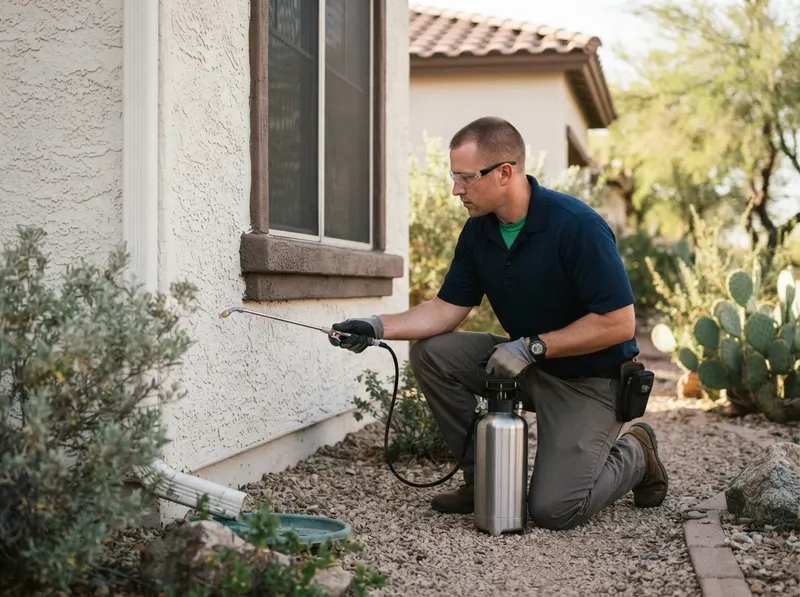
Venomous arachnids in the Sonoran Desert establish harborage within architectural voids common to Maricopa County homes. Western black widows (Latrodectus hesperus) consistently nest in low-elevation, undisturbed recesses such as stucco weep screeds, irrigation control boxes, pool pump housings, and block-wall expansion joints. In neighborhoods with abundant surface water and dense ornamental landscaping like Ocotillo, Fulton Ranch, and Andersen Springs, elevated midge and mosquito populations provide an ongoing prey base that accelerates spider reproduction along covered patios and garage entryways. Structural defense requires systematic mechanical disruption: technicians physically sweep webs with specialized extension poles to remove egg sacs, which contain roughly 200 to 900 spiderlings each, preventing seasonal indoor dispersal.
A primary chemical barrier must address the unique biology of spiders compared to common insects. Because spiders suspend their bodies on elevated legs and do not groom their tarsi, broad-cast floor sprays yield limited transfer of active residues. Targeted defense utilizes microencapsulated pyrethroid products applied directly into wall voids, weep holes, and the lower perimeter of foundation stems where spiders make contact. Properties backing up to native washes or agricultural boundaries near Sun Groves, Fox Crossing, and Circle G at Riggs Homestead encounter increased pressure from cursorial hunting species, such as wolf spiders and ground spiders, which do not build webs. For these perimeters, a granular repellant band laid 3 to 5 feet outward from the foundation interrupts ground-level movement before specimens access sliding door tracks or weather stripping.
Selecting treatment scope depends on the age of the structure and interior infestation levels. An exterior-only barrier fits homes in master-planned communities like Clemente Ranch and Cooper Commons experiencing peripheral web construction under fascia boards and window frames without indoor sightings; this protocol keeps active chemistry entirely outside living quarters to protect small children and indoor pets. Conversely, older block-construction homes in the Galveston district frequently require combined interior perimeter treatments and attic void dusting when wolf spiders or cellar spiders migrate into living spaces through unsealed plumbing penetrations. The operational trade-off centers on prep work: an interior treatment requires pulling perimeter furniture 12 inches away from walls and keeping occupants off treated floor areas for 2 hours while water-based applications dry completely.
Every job gets a firm, written price after a free on-site visit.
Tell us about your spider control job in Chandler and we'll send a clear, written quote, usually the same day.
 Northwind Pest Control